Results
No exact match, try with fewer filters or a more generic term
In a DMX-based system, each device responds to digital commands transmitted over a shared communication line. A DMX LED dimmer interprets those commands and regulates the electrical output supplied to the LED load.
Unlike a simple switching device, which only changes state, a dimmer continuously adjusts the output level. This enables smooth transitions, controlled fades, and consistent behavior across multiple channels.
A key aspect of DMX control is that the dimmer follows instructions from the system controller rather than determining its own behavior locally. This allows connected lighting loads to respond in a coordinated way.
DMX control data is transmitted unidirectionally from the controller to receiving devices. A controller continuously sends packets containing values for each channel. RDM-capable devices add bidirectional communication for device configuration and monitoring.
Based on its start address, the dimmer continuously processes its assigned range of DMX channels in real time and updates its outputs as the channel values change.
Each dimmer is mapped to one or more channels. A single-channel device controls intensity only, while multi-channel DMX dimmers can manage several outputs independently, as typically required for RGB, RGBW, or tunable white systems.
Addressing determines where in the DMX data stream the device begins reading data. Correct addressing ensures that each output corresponds to the intended control parameter.
For LED loads, dimming is typically achieved through Pulse Width Modulation (PWM). The output is switched rapidly on and off, and the average power delivered to the LED determines the perceived brightness.
Switching frequency is a critical parameter. If it is too low, flicker can become visible, particularly in video applications. With appropriate design, the dimmer can maintain stable output even at very low dimming levels.
The DMX signal is distributed along a daisy-chain line, with devices connected sequentially and the line terminated at its far end. Signal quality and correct termination are important factors, particularly in large installations.
The dimmer requires suitable input circuitry for reliable operation in electrically noisy environments.
From an engineering perspective, not all DMX dimmers offer the same performance. Their behavior depends on several design factors.
The number of channels determines how many independent loads can be controlled and directly affects flexibility in multi-color or multi-zone installations.
The distinction between constant-voltage and constant-current outputs determines compatibility with different LED technologies. LED strips commonly use constant-voltage outputs, while many LED modules and spotlights use constant-current outputs.
Another important factor is the dimming curve. Linear control is not always perceived as linear by the human eye, so advanced dimmers allow the response curve to be adjusted for smoother visual transitions.
Operating frequency, thermal behavior, and protection mechanisms also play an important role in real installations, particularly under continuous operation or high-load conditions.
Wired DMX control has expanded beyond temporary entertainment and stage applications into permanent architectural and high-end commercial projects requiring programmable lighting.
In architectural projects, DMX control allows lighting designers to create scenes and transitions that respond to time of day or user interaction. In retail and hospitality environments, it contributes to atmosphere and the overall visual experience.
In more dynamic environments, such as events or installations with changing conditions, the ability to control multiple light sources in a synchronized way becomes essential.
In LED-based systems, DMX dimming can control not only intensity but also color mixing and tunable white with precision.
Selecting a DMX dimmer is not simply a matter of matching power ratings. It also requires an understanding of how the device will operate within the overall system.
The electrical characteristics must match the load, including voltage range, current per channel, and total power. Beyond this, configuration capabilities become increasingly important.
In complex systems, the ability to adjust parameters such as PWM frequency, dimming curve, or channel behavior allows installers to fine-tune performance without modifying the hardware.
Integration is another key consideration. The dimmer must operate reliably with the selected control system and support the required communication features, including remote configuration where needed.
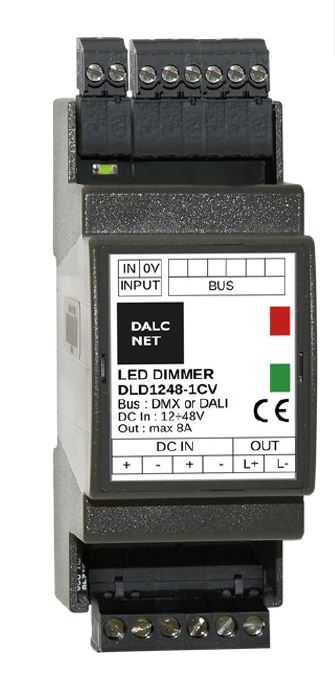
Dalcnet DMX dimmers are developed with a focus on control precision and system flexibility. Rather than functioning as passive devices, they are designed to adapt to different installation requirements through configurable parameters.
The control stage allows dimming behavior to be optimized, while Dalcnet offers output configurations designed for stable operation across a wide range of LED loads.
Particular attention is given to high-frequency PWM operation, which is fundamental in applications where flicker must be minimized, such as architectural lighting and video environments.
Selected Dalcnet models allow parameters to be configured through dedicated tools while the device is switched off or during operation, simplifying commissioning and maintenance.
The result is a dimming solution that integrates cleanly into both small- and large-scale installations while maintaining consistent performance over time.
The controller generates the control signal. The dimmer receives and interprets it to regulate the electrical output supplied to the lighting load.
A standard DMX universe provides up to 512 control channels. The number of connected devices depends on both their channel requirements and the electrical loading of the DMX line.
Yes. Multi-channel dimmers are designed to control each color channel independently.
Yes. While originally developed for stage lighting, DMX is widely used today in architectural applications requiring dynamic control.